Blogs
Insightful discussions on building better culture
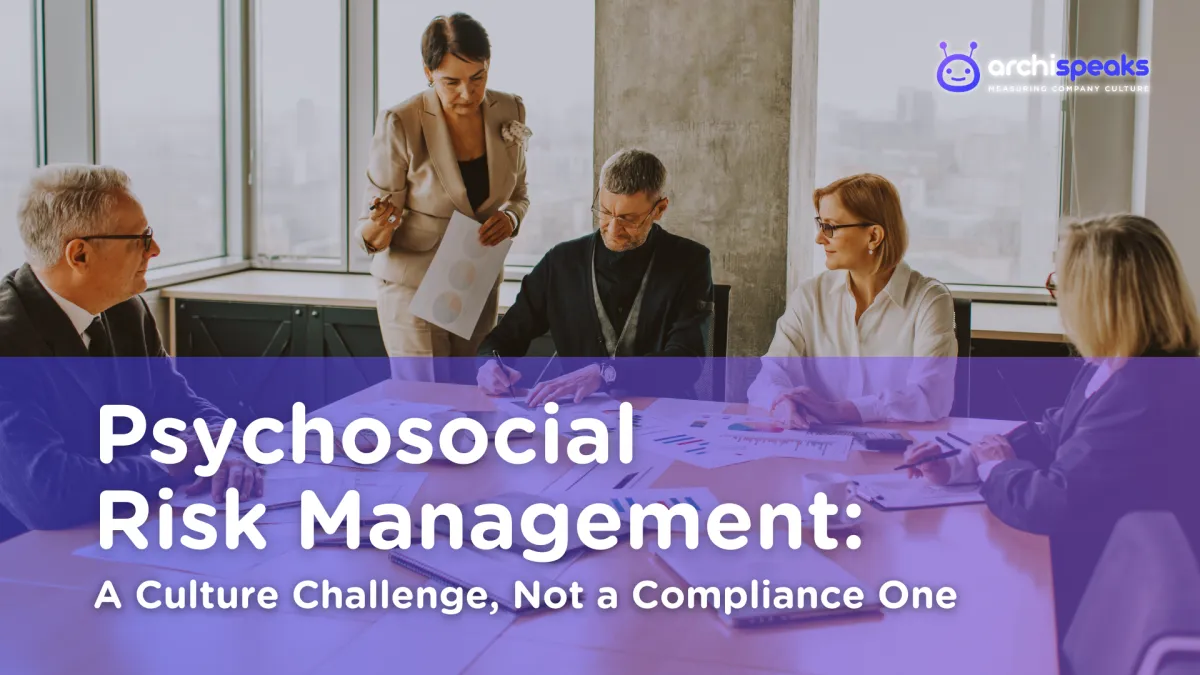
Psychosocial Risk Management: A Culture Challenge, Not a Compliance One
When it comes to psychosocial risk management, most organisations are focusing on compliance, but that’s not really where the challenge lies.
The real challenge is culture. And the real solution- and opportunity, is collaboration.
Because if we’re honest, the compliance requirement itself is fairly straightforward. The steps are clear: identify the psychosocial hazards, assess the risk, put controls in place, and monitor and review.
That’s it.
Yet most organisations are finding that psychosocial compliance feels harder than it should be. Not because the process is complex, but because the ownership is fragmented.
Whose Job Is It, Really?
Here’s what I’m hearing from organisations every week:
“It sits with HR.”
“No, it’s Health and Safety.”
“Actually, isn’t this an executive risk issue?”
“We’ll need Legal and IR involved.”
They’re all right…and that’s exactly the problem.
Psychosocial risk management is a shared responsibility, sitting at the intersection of HR, HSE, Legal, IR, and leadership. Everyone has a role to play, but when everyone is responsible, it’s easy for no one to feel accountable.
So, while compliance is easy to define, collaboration is harder to do.
Collaboration: The Missing Link
Despite decades of research proving the benefits of collaboration, it still feels aspirational for many workplaces. Teams are busy, priorities clash, and even with the best intentions, cross-functional coordination is often the first thing to fall through the cracks.
Yet the data is clear, collaboration isn’t just a “nice to have.” It directly affects performance, safety, and engagement.
According to Gallup’s global research, highly engaged teams see:
21% higher profitability
41% lower absenteeism, and:
59% less turnover.
In safety-critical industries like mining, studies have shown that highly engaged workforces experience up to 74% fewer safety incidents.
That’s not a compliance outcome. That’s an organisational outcome.
When people are engaged, empowered, and connected across functions, they don’t just comply, they care.
Culture Is the Control
The code of practice makes it clear that organisations must identify, assess, control, and monitor psychosocial hazards, through confidential employee engagement, but no piece of legislation can teach people how to collaborate.
The success of any psychosocial risk management framework depends on culture, the invisible system of trust, communication, and accountability that determines how well people actually work together.
And culture isn’t built in a policy or a meeting. It’s built in the daily interactions between teams, functions, and leaders, those micro-moments where people choose whether to share information, escalate an issue, or take ownership.
If those relationships are fractured, no compliance process will hold. But when collaboration is strong, compliance becomes effortless.
Collaboration is Also the Opportunity
This is the mindset shift that changes everything:
Compliance is the baseline. Collaboration is the multiplier.
When leaders come together, cross functionally, to co-design frameworks for organisational outcomes, something powerful happens.
Risk management becomes shared leadership accountability with top down buy in that encourages bottom up en engagement.
Safety and culture stop competing for attention.
The organisation starts speaking a single language, one built on prevention, insight, and care.
That’s the kind of environment where compliance takes care of itself, because culture is doing the heavy lifting.
Cutting Through the Complexity
The good news is, building a collaborative approach to psychosocial risk management doesn’t have to be complex.
It starts with a few simple questions:
Clarity: Do we have shared clarity on our obligations and roles?
Confidence: Are we engaging our people in identifying and addressing psychosocial risks in real time?
Capability: Do our leaders have the insight and confidence to take action early?
That’s where simplified frameworks and tools, like the psychosocial pulse approach we use at Archispeaks, can make all the difference.
By capturing live insights from across your workforce and presenting them in one shared view, we help organisations move from siloed to synchronised.
The Takeaway
The challenge of psychosocial risk management isn’t compliance, it’s collaboration. The solution isn’t more paperwork, it’s shared ownership and culture.
The organisations that get this right will not only meet their obligations, they’ll create workplaces that are safer, more engaged, and better aligned than ever before.
If you’d like to explore a simplified, collaborative approach to psychosocial risk management, one that cuts through the complexity and builds compliance through culture, let’s talk.
📩 Reach out to start a conversation about creating a collaboration-enhanced culture that drives both compliance and performance.